
Beach handball: application and influence on indoor handball
 In previous text, which was published in 3 parts on our site (author: Tamas Neukum), beach handball and indoor handball were compared. So, we think we should publish this article in episodes written by Davor Rokavec, a worthy member of Croatian Beach Handball Team which won 2008 World Championship held in Cadiz. Author `s beach handball career is full of achievements and good results crowned by gold medal from last WC. In preparations for WC at Cadiz he was in charge for physical readiness of players in Croatian National Team. We hope you will enjoy reading his story.
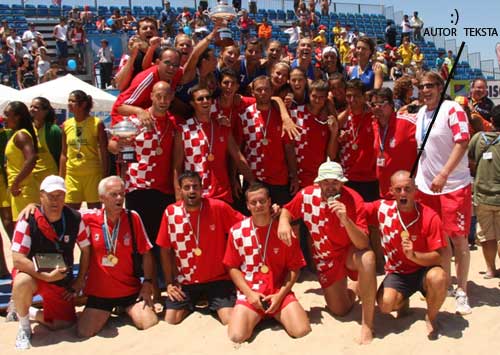
The well-known member of the Olympic sports family, “decathlon with a ball” or, as some like to call it – handball, recently got a summer version– beach handball, which is spreading and developing at unbelivable speed. The «younger brother» was fast accepted and won the hearts of many people; not only of the active and less active «indoor» handball players, but also of other people, which were recently just spectators, who did not have the courage to try their potential indoors, but found themselves in the summer, sand version of handball. The fact that the beach handball is played in traditionally non-handball countries as England, Belgium, Netherlands, Cyprus, Uruguay, Pakistan, Iran, Togo and many others, proves that the simplicity and amusement of this sport made it famous in the world of sport, simultaneously popularizing the indoor handball.
So, the word is about sport which turned up as an alternative to indoor handball, in order to fill the gap between two competitive seasons, and to maintain acceptable level of physical readiness of the players while at the same time they would recover psychologically and relax. Therefore, the emphasis in the beach handball is on the entertainment and the attractiveness of the game itself, as the tensions and the anxiety are minimal. Beach handball has many similarities to the indoor handball, as well as many differences – smaller field, different surface, less players, differences in the technical and tactical preferences….
As everything novelty, beach handball was welcomed with enthusiasm, as well as with resistance and contrariness. Given that, certain circle of coaches has appeared, who were skeptic to the new sport, even forbidden their players to play beach handball, stating possible injury as the reason ?! Now, the question arises – are these coaches right forbidding their players to enjoy the beach handball or is this skepticism and prohibition as a result are just consequences of their lack of knowledge about the features which that version of handball has to offer? Although direct translation of the word skepticism means lack of trust, as the word comes from the Greek word skepsa which means thinking, revising; conclusion can be made that skepticism is not bad actually and that these are things which coaches should accept before performing and rushing to any conclusions. Motivated by the above mentioned issues, I started researching and analyzing the positive and negative sides of the beach handball, i.e. of any training on sand, as well as their application and influence on the indoor handball.
How does training on sand work??
Have you ever tried jumping on a trampoline and then tried to jump on the solid ground? The feeling you get is that your legs become very heavy and there is no ability of jumping. The reason is that the trampoline not only absorbs and spreads all the forces when landing, which reduces the stretch-shortening reflex, but also performs all the work necessary to direct the body back in the air. This means that the muscles, as well as central nervous system, receive the message that their activity is not necessary, and therefore shut down. Jumping on the sand has a similar effect as trampoline, as the permeability of the sand during the landing, absorbs and disperse the forces, which takes away any plyometric advantages of the stretch-shortening cycle.
On the other hand, the sand will intensify the work of the muscles, in order to performe any jump at all as well as the jump hight. Therefore, when training takes place on sand, the ground reaction forces on which the athletes relies in the gym, are modified by changeable and permeable surface which yields when the athlete applies muscle force. The lack of ability to produce the ground reaction forces challenges and disturbs stability of the entire body as well as use of triple-extension mechanism (ankle, knee and hip) which aim is propulsion. This means that during movements in sand, the ankle is limited by force it can produce because part of applied force is lost due to the instability of sand. The instability and permeability of the sand require additional overwork of the muscles and tendons of the foot, in order to stabilize the foot, which results in greater energy consumption. Increase of the energy consumption, during movements in sand, caused by the instability of the surface, is result of additional mechanical work and reduced efficiency of positive muscles and tendons actions. In order to compensate for these forces` modifications, the body tries to balance and equalize the movement by increasing the force and amplitude of extension in the hip. Activation of larger number of muscle fibers than while performing same moves on solid ground explains very perceptible feeling of quick tiredness while training on sand. Although at the first sight, it seems as the differences in mechanics between the indoor and beach handball are minimal, actually the differences of the performance environment and variability of the surface force the player to use quite different movements in order to have a successful performance. It seems that sport performed on sand is different regarding the same sport performed on the solid ground, due to the fact that the permeability as well as abrasion on the sand require usage of methods who control movements that are quite different than the ones on the solid ground. Therefore, during training on the sand more effort, higher energy consumption and higher blood lactate concentration have been recorded than during training on solid and/or grass surfaces.